Staff Spotlight: Dmitry Borisov

This Staff Spotlight features Assistant Research Professor and Geophysicist Dmitry Borisov and his work as part of the KGS team.
By Ally Pruente
Exploring the Earth’s subsurface involves complex computing methods and critical thinking. When looking for what lies beneath our feet, Assistant Research Professor and Geophysicist Dmitry Borisov also relies on a sense of curiosity.
“In many ways, geophysics is analogous to medical imaging,” Borisov said. “Just as doctors use imaging technologies to see inside the human body, geophysicists use various sensing and imaging techniques to visualize the Earth’s interior.”
When studying the subsurface, Borisov’s goal is to identify rock layers as well as areas that may contain sinkholes, voids, or other spaces of overall geologic interest. Many factors can impact findings.
Borisov is now investigating seismic noise from trains and traffic in Hutchinson and how these vibrations affect the condition of salt cavities, also known as jugs. This KGS project began decades ago, as salt mining has a long history in Hutchinson.
Salt mining creates underground cavities that could lead to subsidence, or sinking of the ground that may pose a risk to public safety or roads, utilities, and other critical infrastructure.
“What makes this project especially interesting is that we do not rely on conventional active seismic sources to image the subsurface,” Borisov said. “Instead, we use vibrations generated by human activities and apply a technique known as seismic interferometry.”
The technique measures two kinds of waves such as radio, light, or sound and uses the combined data to monitor changes in the ground. According to Borisov, this cost-effective method aims to identify areas that may be at risk of subsidence.
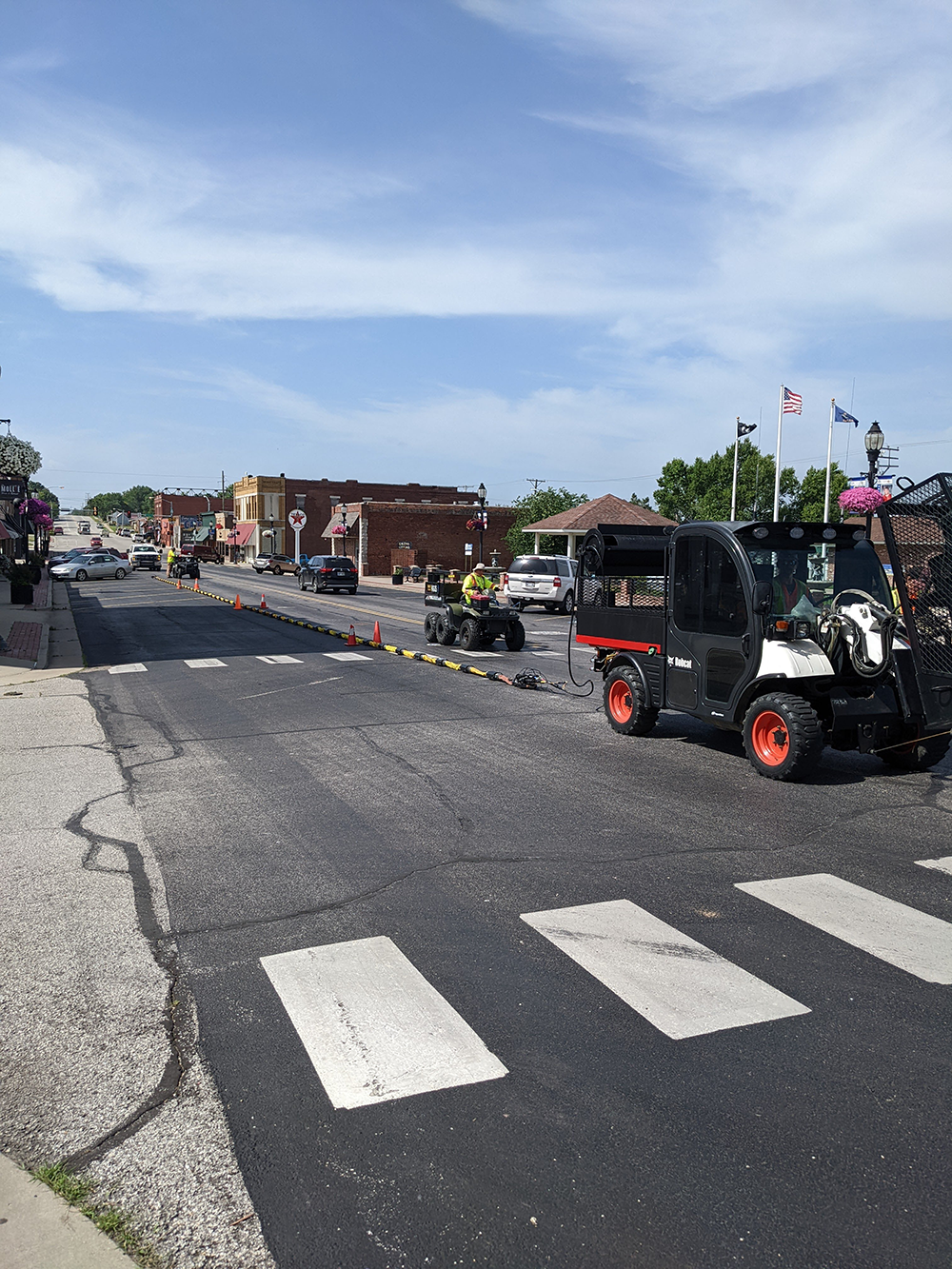
The KGS exploration crew collects seismic field data to learn more about subsurface risks in Kansas. Here, the crew works in Galena, where underground ore mine remnants present potential hazards.
“Although this is a quite large project by near-surface geophysics standards, the use of passive seismic sources — primarily train and traffic vibrations — rather than active sources helps keep data acquisition and monitoring costs relatively low,” Borisov said. “Passive monitoring is not the best solution for every site, since geologic and logistical conditions vary, but it appears to be particularly well suited for this project.”
Borisov said the data that KGS collects can inform Kansans living in areas with potential subsidence, as the existence of an underground cavity does not necessarily mean that a collapse will occur.
“Our goal is to use scientific methods to better understand subsurface conditions, identify potential risks, and provide reliable information for decision-making,” Borisov said. “Continued monitoring and research help reduce uncertainty and support efforts to protect public safety and infrastructure.”
For projects like this, Borisov relies on colleagues.
“The type of work I do is highly interdisciplinary, and successful projects require collaboration among people with a wide range of expertise and backgrounds,” Borisov said. “I work closely with colleagues from our exploration program, including engineers, software developers, data-processing specialists, and field acquisition crew.”
He enjoys how his career combines mathematics, physics, and geology to create a better understanding of our Earth.
“Being able to contribute to projects that have a direct impact on public safety, environmental protection, and infrastructure resilience is a major source of motivation for me,” Borisov said. “I find it particularly rewarding when my work can help communities make informed decisions, mitigate risks, and better manage natural resources.”