Staff Spotlight: Kate Andrzejewski

This Staff Spotlight features Assistant Scientist of Stratigraphy Kate Andrzejewski and her work as part of the KGS team.
By Ally Pruente
Surrounded by a whiteboard full of notes, fossils discovered during field sessions, and photos of her two kids, Kate Andrzejewski focuses on her computer during another afternoon of work at the Kansas Geological Survey.
Each day Andrzejewski blends the line between geology and paleontology through her research as an assistant scientist of stratigraphy.
“As a stratigrapher, I’m always looking at units of the geology of Kansas,” Andrzejewski said. “I’ve worked on everything from Quaternary all the way back to the Pennsylvanian, but my favorite time period is the Cretaceous. So if you ask anyone around here, that’s usually the time period I’m working on.”
Andrzejewski’s research in the Cretaceous Period spans a variety of topics, including surficial and subsurface geologic mapping, stratigraphic correlations, paleoclimate reconstruction, and the occasional vertebrate fossil. She spends at least one session a month doing field work with the rest of her time split between the office and the lab.
Andrzejewski, who grew up in Topeka, completed her undergraduate degree at the University of Kansas before proceeding to Southern Methodist University in Dallas to complete her Ph.D. Andrzejewski has worked in the Energy and Stratigraphy division at the KGS since 2021 when she started as an assistant research professor. She moved into the role of scientist in 2025.
Now, Andrzejewski is contributing to one of her favorite pieces of work yet, the Dakota project, which focuses on the stratigraphy of the Dakota aquifer. The Dakota is located mostly in the western two-thirds of Kansas and holds a variety of rocks, including sandstones, lignites, and mudstones that were deposited about 100 million years ago during the Cretaceous Period.
The Dakota project’s subsurface and surficial geologic mapping is made possible by funds from the U.S. Geological Survey’s STATEMAP program. These maps will help KGS build subsurface models to more fully understand the characteristics of the Dakota aquifer system, an important groundwater resource for the state.
“When I first came to the KGS, I was excited to work on the Dakota [project] because one of my specialities is looking at ancient soils, or paleosols, and the Dakota is full of them,” Andrzejewski said. “Paleosols are great because they record valuable information related to climate and environmental setting, so we can use them to understand important periods in Earth history, like the Cretaceous, when we suspect greenhouse climatic conditions persisted across the globe.”
One of the major goals of the Dakota project is to tie together surface and subsurface information to gain more knowledge about the complex aquifer. The KGS is in phase one of this project, and Andrzejewski anticipates the next four to five years will be needed to cover the subsurface mapping of the state. During her time on this project, Andrzejewski has enjoyed all aspects of the job.
“I am a geologist, but many people don’t know my background is invertebrate paleontology. While that’s not my main focus, it does come in handy,” Andrzejewski said. “I even have a fossil fish we recovered while out working at one of the [Dakota] field sites, and that’s why I love working in the Cretaceous.”
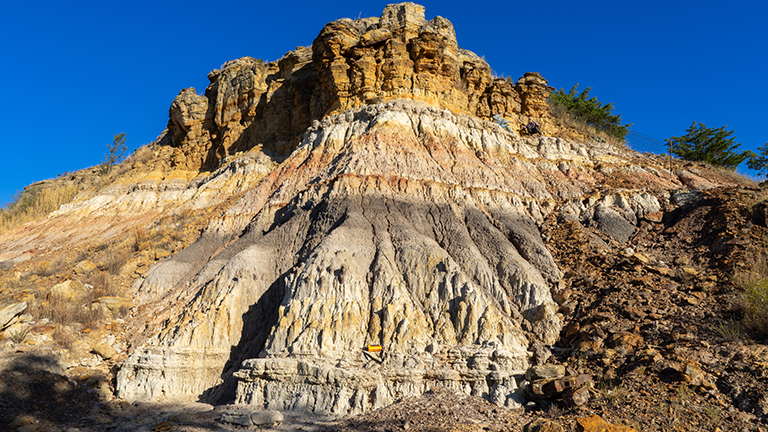
Andzejewski and KGS colleagues Olivia Buchhorn and Alan Peterson gathered samples from this location in the Dakota formation. They found paleosols and overlying deltaic sandstones in this piece of rock along the Saline River just north of Russell
That fossil, however, was somewhat of an ancient puzzle for Andrzejewski. On a rainy day in the fall of 2023, Andrzejewski found some weathered pieces of fossil and began placing them together. The team determined they had the lower jaw of a large bony fish.
After returning to that site the following February, Andrzejewski and a group of undergraduate students found more pieces of weathered fossils. When they learned the Kansas Department of Transportation planned to tear down the site within a month, they launched an emergency excavation to recover the fossil. After battling rain and ice, they successfully removed the head of the bony fish.
“If there was any doubt that it was the same fish we had found before, you can actually perfectly line up the one we found weathered in float with what was found back in February, and it’s a puzzle piece match,” Andrzejewski said.
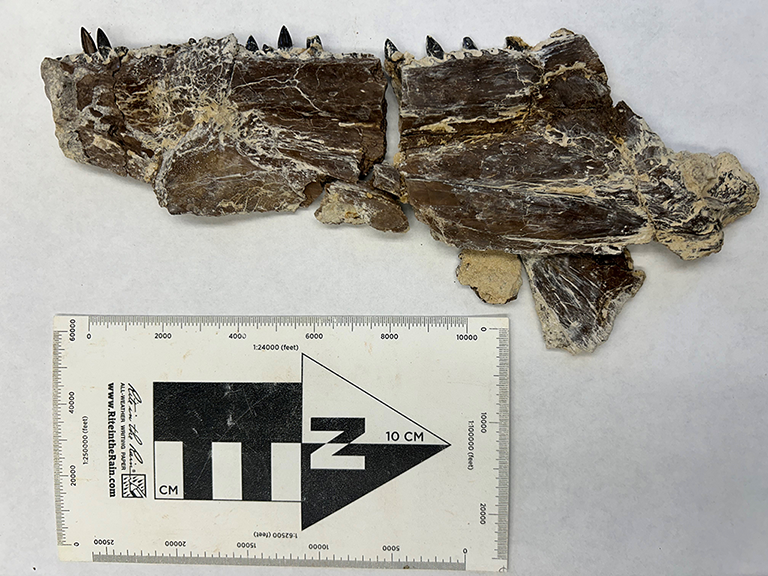
Bony fish right lower jaw bone (dentary) that was assembled from pieces collected from Andrzejewski’s first and second excavation trips.
Andrzejewski loves her day-to-day at the office and all the surprises that come with it. Outside of work, she spends time with her family, including her husband, Kolbe, and two children. Her husband also works at the KGS, and they are popular in their hallway in Parker Hall for bringing in eggs to sell from their hobby farm.
More than anything else, Andrzejewski enjoys that her job allows her to pull from many disciplines and collaborate with many people within the KGS to create quality work.
“You need to have those people that can speak both languages,” Andrzejewski said. “We can bridge the gap between paleontologists and geologists so we can all work together and create really good science.”